
If you own forest land in Ohio, you may have heard of Current Agricultural Use Value (CAUV) and Ohio Forest Tax Law (OFTL). Both programs can reduce property taxes on qualifying woodland, but they do it in very different ways.
That difference matters.
For many woodland owners—particularly in Southeast Ohio—CAUV can provide a substantial financial benefit because it changes the value at which qualifying land is taxed. OFTL takes a different approach: qualifying forest land is taxed at 50% of the local tax rate on its otherwise determined value.
Neither program is simply a property-tax discount for owning trees. Both have eligibility requirements, both are tied to management of the land, and under current rules both involve a three-year history before a new woodland can qualify.
Understanding how they work is the first step toward determining which program may fit your property.
What is CAUV?
CAUV stands for Current Agricultural Use Value.
Normally, real estate is valued for property-tax purposes based on market value. CAUV allows qualifying agricultural land to instead be valued according to its current agricultural use.
Ohio law includes the production of timber for a commercial purpose as a qualifying agricultural use. For tracts totaling at least 10 acres, the land generally must have been devoted to a qualifying agricultural use during the three calendar years before the application year and through the last day of May of the application year. Different income requirements apply to qualifying tracts totaling less than 10 acres.
For woodland owners, the key concept is simple: CAUV can reduce the value at which qualifying forest land is taxed.
A wooded property may have substantial market value because of hunting, recreation, rural homesite demand, or other real-estate factors. CAUV is designed to value qualifying land according to its agricultural use rather than full market value.
What Is Ohio Forest Tax Law?
Ohio Forest Tax Law is a separate program specifically for qualifying forest land devoted to forestry and the production of merchantable forest products.
OFTL does not work like CAUV. Under Ohio Revised Code 5713.23, qualifying forest land is taxed annually at 50% of the local tax rate on its otherwise determined value.
The easiest way to remember the difference is:
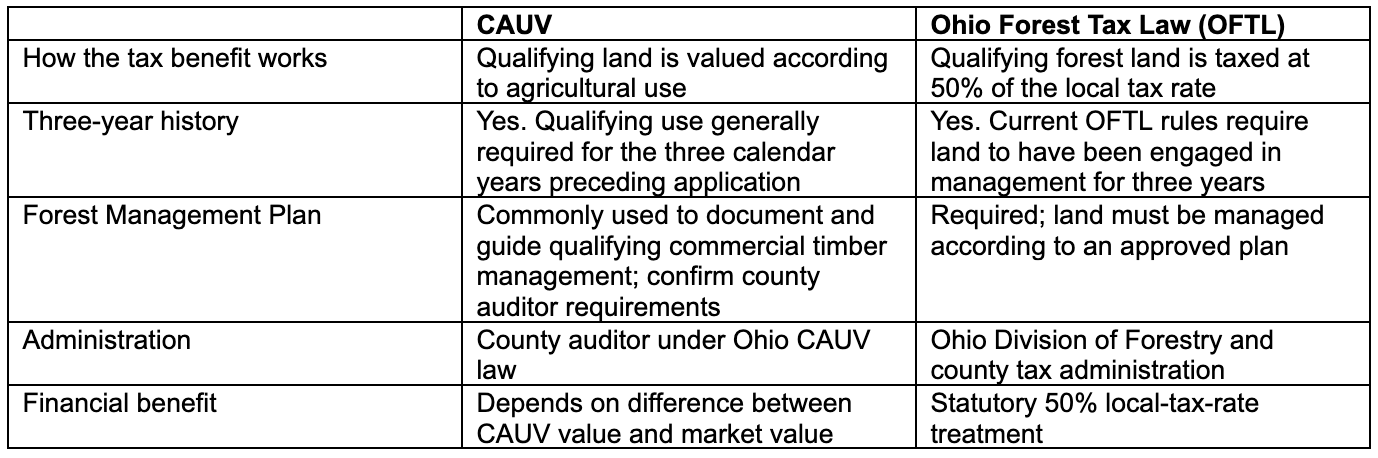
CAUV reduces the value at which qualifying land is taxed.
OFTL reduces the local tax rate applied to qualifying forest land by 50%.
Those mechanisms can produce very different financial results.
How Large Is the CAUV Valuation Benefit?
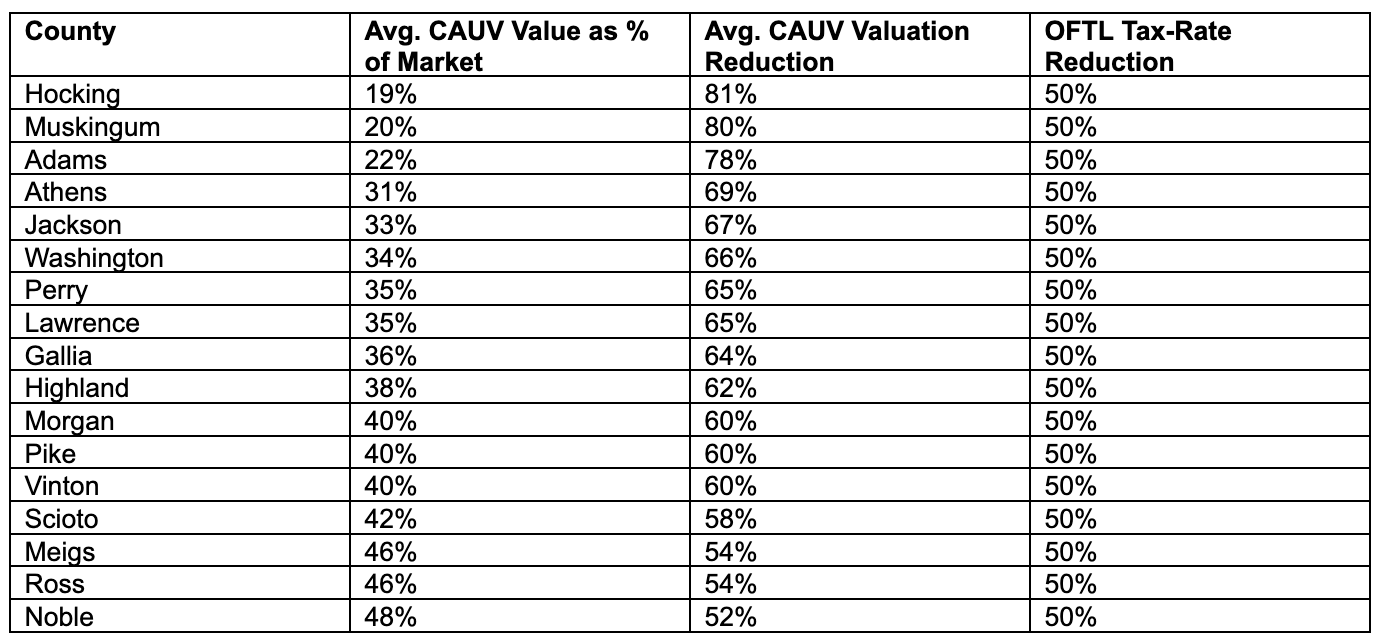
The Ohio Department of Taxation publishes county data comparing CAUV values with market values. The relationship varies considerably by county.
The table below uses published 2024 county CAUV-to-market ratios to show the average difference between CAUV value and market value. The OFTL column shows the statutory 50% local-tax-rate treatment.
Important: These Percentages Measure Different Things
An 81% CAUV valuation reduction does not mean an 81% reduction in the final property-tax bill. The CAUV percentage above is the difference between average CAUV value and average market value. OFTL's 50% figure is a reduction in the applicable local tax rate, not a reduction in property value.
The Ohio Department of Taxation county averages also include all CAUV-enrolled land, not only woodland. They are useful for illustrating the financial mechanics of CAUV across a county, but they are not parcel-specific woodland tax estimates.
What Could That Mean on 50 Forested Acres?
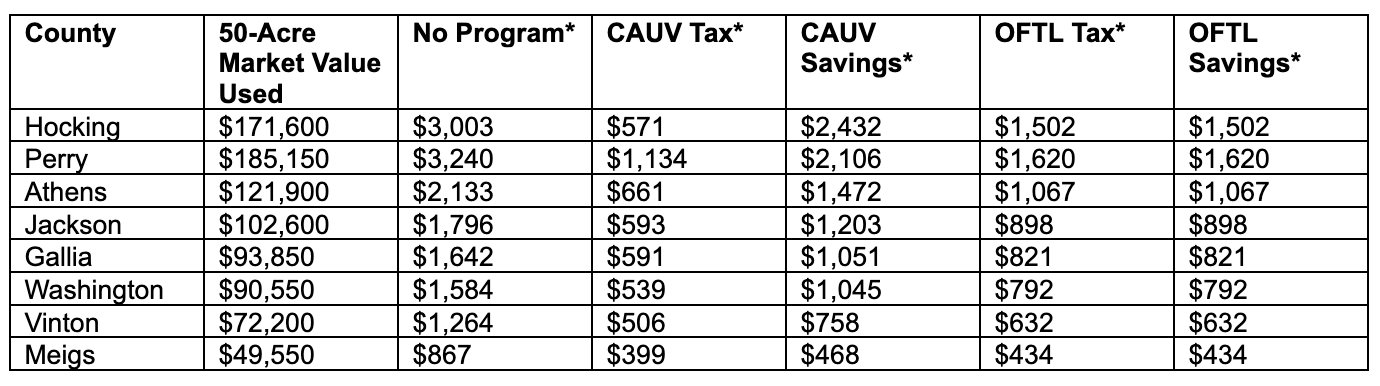
Percentages can be difficult to translate into dollars. The following examples show how the two programs could work on a hypothetical 50-acre property that is completely forested.
To keep the comparison consistent, the illustration uses each county's published average market value per acre of CAUV-enrolled land, its published 2024 CAUV-to-market ratio, Ohio's 35% taxable-value relationship, and an assumed effective tax rate of 50 mills. The same assumed rate is used for every county so the table illustrates the difference between the programs rather than differences among individual tax districts.
*Illustrative only. These are not estimates of the tax bill or savings for a specific parcel. Actual taxes depend on the property's actual valuation, CAUV value, tax district, effective tax rates, levies, credits, and other factors. County CAUV averages include agricultural land other than woodland.
A Simple Hocking County Example
Hocking County illustrates why CAUV can be financially significant in parts of Southeast Ohio. In the Ohio Department of Taxation's 2024 county data, average CAUV value was 19% of average market value—a difference of 81% in valuation.
Using the common assumptions in the 50-acre illustration, the hypothetical annual tax would be approximately $3,003 without either program, $1,502 under OFTL, and $571 under CAUV. That corresponds to illustrative annual savings of about $1,502 under OFTL and $2,432 under CAUV.
Those figures do not mean every 50-acre Hocking County woodland will save those amounts. They show how the two tax mechanisms behave when the same assumptions are applied.
Is CAUV Always the Better Financial Choice?
No. The advantage varies by county and, more importantly, by the individual property.
Meigs County illustrates why. In the 2024 county data, average CAUV value was 46% of average market value, a 54% valuation difference. Under the same 50-acre illustration, CAUV savings are approximately $468 per year and OFTL savings approximately $434 per year—a much smaller difference than the Hocking County example.
The appropriate comparison should therefore be made using the actual parcel rather than a statewide rule of thumb.
The Three-Year Requirement: An Important Change to OFTL
Historically, one important practical difference between CAUV and Ohio Forest Tax Law was how quickly a woodland could qualify. A landowner pursuing CAUV based on commercial timber production generally needed the required history of qualifying use, while OFTL could provide a different path once its planning and management requirements were satisfied.
That distinction has changed.
Under Ohio's current OFTL eligibility rule, effective December 18, 2025, only land that has been engaged in management for three years is eligible to be certified under OFTL. OFTL also requires an approved Forest Management Plan.
This means a new woodland owner should no longer assume that OFTL provides an immediate route to a forest-land property-tax reduction simply by having a management plan prepared.
CAUV Also Has a Three-Year Requirement
For tracts totaling at least 10 acres, current Ohio law generally requires the land to have been devoted to a qualifying agricultural use during the three calendar years before the application year and through the last day of May of the application year. Production of timber for a commercial purpose is specifically included as a qualifying agricultural use.
For a woodland owner starting from scratch, both programs should therefore be viewed as requiring management and documentation over time rather than providing an immediate tax reduction.
Having a Plan Is Not the Same as Having Three Years of Management
This point is especially important under the current OFTL rules. Having a Forest Management Plan prepared does not, by itself, create three years of management history.
The current OFTL rules require land to have been engaged in management for three years before certification. Management must be consistent with the program's forest-management requirements and approved plan.
For a new woodland owner, the practical lesson is to develop the management plan early, begin the appropriate recommended practices, and maintain records of the work completed.
Do I Need a Forest Management Plan for CAUV?
For woodland being enrolled in CAUV as commercial timberland, a Forest Management Plan is commonly used to establish and document how the woods are being managed for the commercial production of timber.
Ohio law recognizes the production of timber for a commercial purpose as an agricultural use that can qualify for CAUV when the applicable acreage, use, and time requirements are met.
A Forest Management Plan provides a written record of that management. It identifies forest stands, describes current conditions, establishes timber-management objectives, recommends practices, and provides a schedule for carrying out that work.
For a woodland owner, the plan serves two purposes: it helps document the commercial management of the woods for CAUV, and it provides a practical roadmap for actually managing the property.
However, CAUV is administered by the county auditor, and Ohio's CAUV statute does not impose a universal statewide requirement that every commercial-timber applicant possess a formal Forest Management Plan. Landowners should confirm the documentation required by their county auditor before applying.
Does OFTL Require a Forest Management Plan?
Yes.
Current Ohio rules require qualifying OFTL forest land to be managed according to a Forest Management Plan approved by the Chief of the Ohio Division of Forestry. The owner must periodically certify compliance, and the Division may examine the forest land to determine whether the approved plan is being followed.
The plan is therefore not simply paperwork used to obtain the tax reduction. It is part of the landowner's ongoing obligation under the program.
CAUV vs. OFTL at a Glance
A Common Misunderstanding About OFTL
OFTL is no longer an immediate alternative for a woodland owner who does not yet have the three-year history needed for CAUV. Current OFTL rules also require three years of management before the land is eligible for certification.
What If I Want EQIP Funding for Forestry Work?
A Forest Management Plan can also be important when pursuing USDA Natural Resources Conservation Service forestry assistance. Forest planning identifies resource concerns, establishes objectives, and lays out appropriate conservation practices that may later be considered for financial assistance. Program eligibility, contracting, and funding are separate decisions and are not guaranteed simply because a management plan exists.
Which Program Should a Woodland Owner Consider?
Rather than choosing a program based on one percentage, start with four questions:
Does my property qualify?
What would my actual property taxes be under each program?
What management and documentation requirements would I be agreeing to?
Which program fits what I actually want to accomplish with my woods?
For many qualifying Southeast Ohio woodland properties, CAUV deserves careful consideration because the difference between market value and agricultural-use value can be substantial. OFTL remains a significant program in its own right, with a clearly defined forest-management structure and statutory 50% local-tax-rate treatment.
The best comparison should ultimately be made using your property, your county, and your tax district—not a county average alone.
Start With a Plan for Your Woods
Whichever tax program you are considering, the larger objective should be good long-term forest management.
A Forest Management Plan can identify forest stands, evaluate timber and wildlife opportunities, document invasive species and other concerns, establish management priorities, and provide a schedule for future work.
At Feicht Forestry, our Forest Management Plans are designed as 10-year roadmaps for Ohio woodland owners. The objective is not simply to complete paperwork for a tax program. It is to help you understand what you own, what your woods need, and what you should do next.
Learn About Ohio Forest Tax Law
Learn About Forest Management Plans
